



Almost every leader has been there: It’s the start of the quarter, you have big goals to hit, but your budget still hasn’t been finalized. Or worse, the numbers just changed, and now you have to cut costs without missing your deadlines.
We like to pretend we operate in a world of predictable roadmaps and guaranteed funding. But the reality of leading R&D and product teams is much messier. Most of the time, we are managing through delayed approvals, surprise cuts, and shifting priorities.
A while back, Harvard Business Review researchers interviewed over 1,500 leaders across 90 countries to find out what skills matter most in a volatile, post-covid world. The data came back with four words:
Adaptability
Curiosity
Creativity
Comfort with Ambiguity
These aren’t just nice-to-have traits for a performance review. They are heavily connected.
Here is how they play out in real life:
Curiosity is your radar. It is what drives you to actually talk to customers, watch the market, and spot when things are changing before they hit your team over the head.
Adaptability is your pivot. Seeing a shift doesn’t help if you don’t do anything about it. Adaptability is the muscle to change your approach when the facts change.
Creativity is your spark. When you have to pivot, you can’t just copy old playbooks. You have to invent new ways to solve new problems.
But none of this works without the last one: Comfort with Ambiguity.
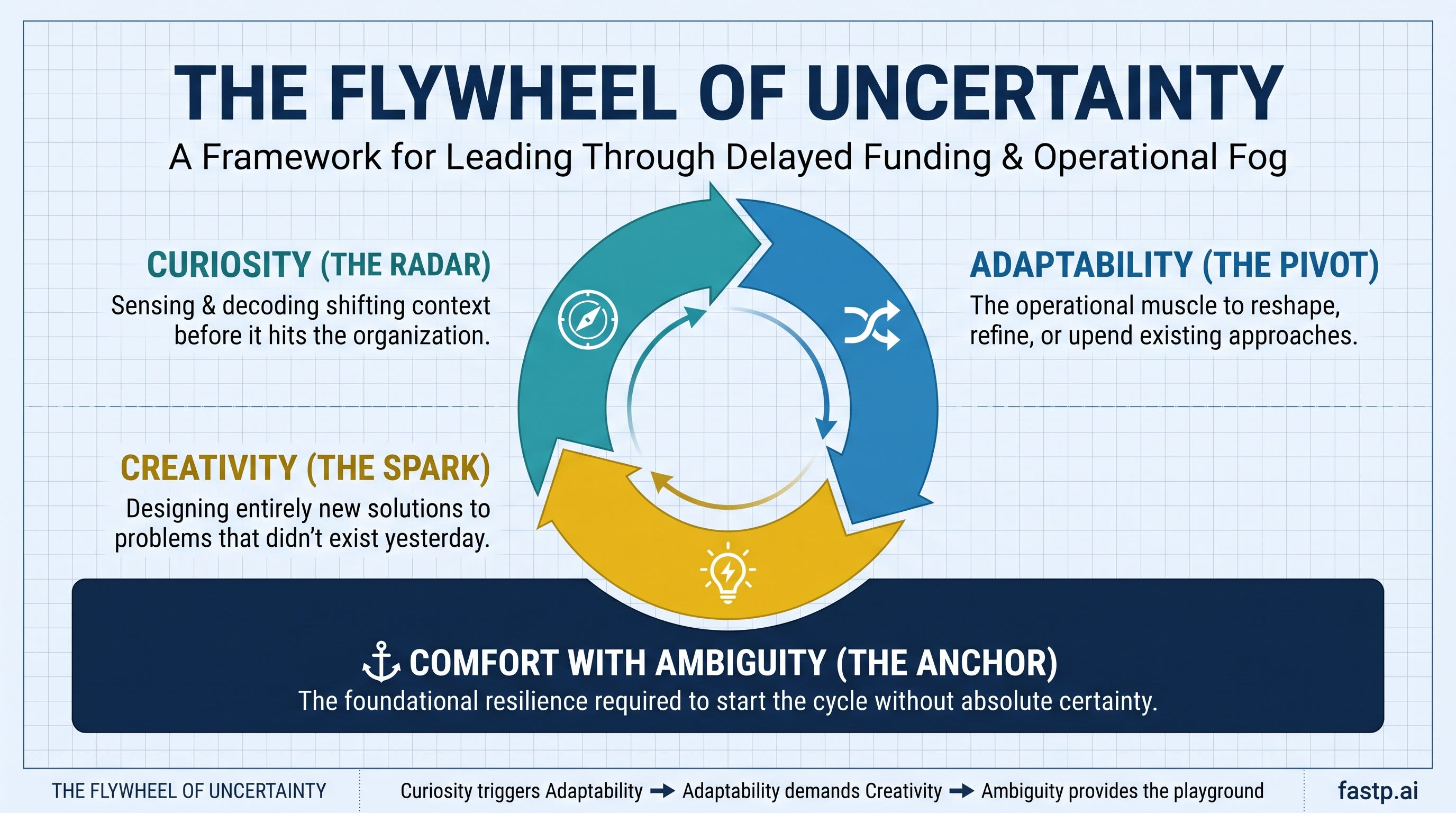
Ambiguity is the foundation. If you need absolute certainty before you make a move, you will just sit there, paralyzed, waiting for a perfect plan that never actually comes.
Ambiguity in Action: “How do we work without a budget?”
It’s easy to write about leadership traits in an article. It’s a lot harder on a Tuesday morning when the reality of shifting budgets and funding freezes actually hits you.
The most common test of this “comfort with ambiguity” in any organisation is being told to run complex operations when your final budget hasn’t been approved, or when a sudden cut has just thrown your roadmaps into question.
People naturally ask: “How are we actually supposed to get anything done when we don’t even know what our resources are?”
It is a fair, incredibly frustrating question. Anyone who has survived a corporate budget cycle knows this exact waiting game.
But this is exactly what ambiguity looks like.
It is uncomfortable, and pretending otherwise is useless. But not having a finalized budget is not an excuse to stop. Ambiguity does not mean we sit on our hands and wait for perfect clarity to drop from the ceiling.
If we wait for perfect parameters, we won’t do anything.
How to Keep Moving When the Picture is Blurry
When you can’t control the big picture, you have to sharpen your focus on the small things you can control. Here is how we do that:
Deconstruct the Elephant: Don’t try to solve the entire year when you don’t have the numbers for it. Cut the massive, overwhelming uncertainty into smaller, manageable chunks (Pixel is all you need). You don’t need a 12-month budget to decide what your team needs to achieve in the next two weeks. Focus on the next sprint.
Anchor to the Constants: Focus on what is not changing. Your baseline team, your core technical capabilities, and your daily operating costs do not disappear overnight. Look for the solid ground and build on that.
Focus on Commitments: Budgets and roadmaps can shift, but your core delivery commitments for the year are usually still there. Rely on the milestones right in front of you. When money gets tight, it actually forces you to be creative about what is absolutely necessary and what is just nice to have.
The final destination is rarely visible from the starting line. If we wait for the fog to completely clear before we take a step, we will get left behind.
The job isn’t to wait for the uncertainty to go away. The job is to get comfortable with the fog, trust your team, and keep moving forward anyway.
What is the biggest piece of budget or operational ambiguity your team is navigating right now, and how are you keeping them moving? Let’s talk in the comments.