


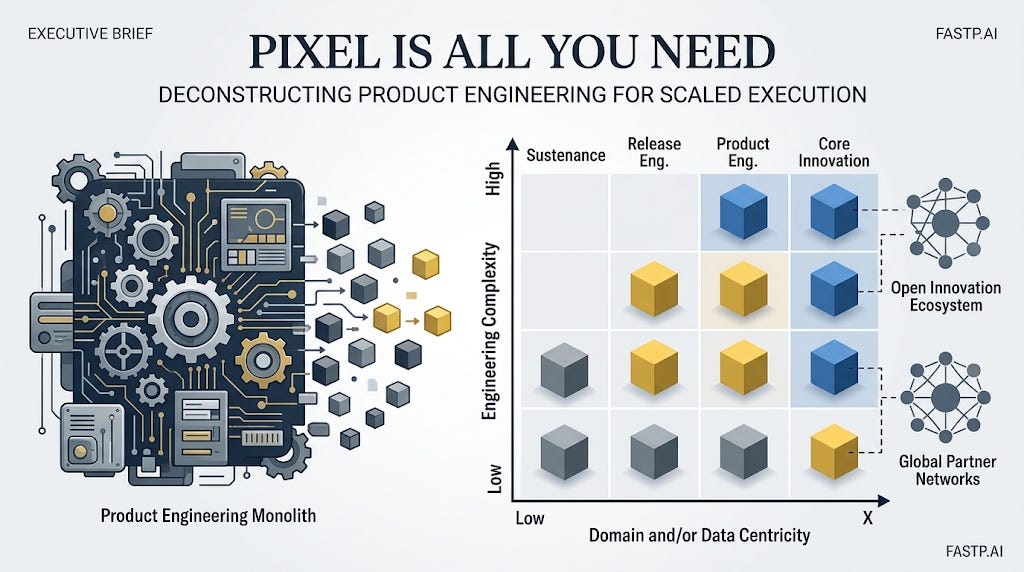
In 2017, the landmark paper “Attention Is All You Need” redefined artificial intelligence. By abandoning recurrent monoliths and breaking language down into atomic tokens, the transformer architecture allowed models to dynamically compute where to focus attention and energy.
In physical and digital product development, engineering executives face an identical scaling bottleneck.
Historically, leadership teams approach this monolithically. We look at an entire product line, platform, or development program as a single, indivisible block of work. We either try to staff the entire engine in-house—hitting immediate talent bottlenecks—or we attempt to outsource monolithic chunks of execution, only to discover that the partner lacks our core domain intuition.
At the beginning of 2026, driven by the need to solve this friction across our global R&D footprint, I set out to build a simple framework to map organizational competencies - a simple X-Y matrix of Domain Centricity versus Engineering Complexity.
Over the last ten months, this model evolved into an organizational transformer. It breaks the intimidating monolith of complex product engineering into discrete, manageable competency pixels. At the pixel level, you can point organizational attention with surgical precision—deciding exactly what must stay in-house, what belongs in a co-development model, and what can be scaled across an open innovation ecosystem.
Moving Beyond Deloitte’s “Pixel”
When looking at the mature state of this model, the conceptual ancestry is clear: it shares DNA with Deloitte’s Pixel (A): Consulting with Open Talent.
Deloitte pioneered the idea of breaking down consulting engagements into modular, well-scoped tasks executed by open talent networks. But in complex industrial systems and physical-to-digital product engineering, pixelating individual project tasks is not enough.
Tasks are transient; competencies are structural. If you only pixelate a project schedule, you end up micromanaging external work packages on a Gantt chart.
Instead of disaggregating an isolated project, this framework pixelates the entire product engineering competency landscape
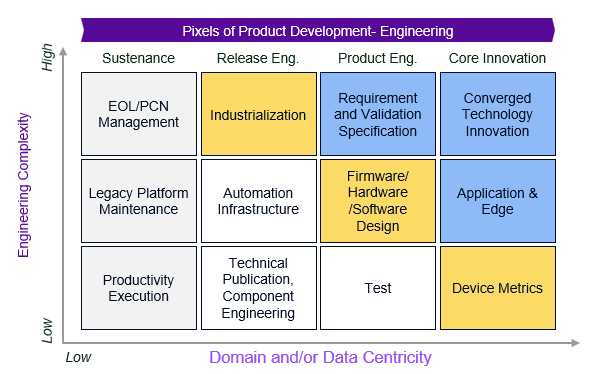
(The Competency Transformer: Architectural View)
The framework evaluates competencies across two independent dimensions:
The X-Axis (Domain and/or Data Centricity): How deeply coupled is the skill to your proprietary data, customer workflows, and core intellectual property? It moves progressively across four archetypes: Sustenance → Release Engineering → Product Engineering → Core Innovation.
The Y-Axis (Engineering Complexity): What level of technical rigor, toolchain sophistication, and engineering pedigree is required, independent of domain intimacy?
The Blueprint for Scaled Execution
Pixelating the landscape is only the diagnostic step. The real breakthrough lies in operationalizing it for scaled global execution:
1. Tokenizing Decisions: Ending the Monolithic Outsourcing Debate
When an engineering team debates whether to “outsource development,” the conversation frequently stalls in political deadlock. Pixelation changes the question. You no longer ask, “Should we build this in-house or partner?” You ask, “Which pixel are we discussing?”
White Pixels (Scalable Sourcing): Productivity, cost down execution, legacy platform maintenance, technical publications, component engineering, and automated testing. These demand engineering rigor but low domain centricity. They belong in scalable engineering ecosystems (internal and/or external).
Yellow Pixels (Collaborative Co-Development): Industrialization, firmware/hardware/software design, and device metrics. These sit at the operational pivot point. They are technical heavy-lifters that require structured shared-outcome models.
Blue Pixels (The Inviolable Moat): Requirement and validation specifications, application and edge development, and converged technology innovation. These hold your primary competitive alpha. They require maximum internal attention and should never be abdicated.
2. Phased Migration
Scaled execution across an ecosystem is not a static binary - it is a progression:
Stabilization & Interface Locking: Internal architects retain strict control of system-level specifications while setting clear API and interface contracts. Partner teams are integrated into well-bounded, modular engineering pixels (e.g., test suites, automation infrastructure, component qualification).
Ecosystem Absorption & Velocity Scaling: As the open innovation partner internalizes your operational rhythm and tooling, you transfer execution velocity on complex build pixels (such as core HW/SW implementation and industrialization). Meanwhile, your internal teams redirect their attention entirely toward high-domain edge innovation and specification definition.
3. Defining Clean “Data Contracts” Between Pixels
The fundamental breakdown in open innovation happens when the boundaries between disciplines are blurry. By treating each competency as a pixel, you can define explicit inputs and outputs:
Your internal team owns the Requirement and Validation Specification (the data contract).
The open innovation partner executes the Firmware / Hardware / Software Design inside that contract.
Validation against the specification proves outcome delivery without requiring internal micro-management of day-to-day schematic drafts.
Case in Point: An Industrial Sensing Manufacturer
To see this in action, apply the matrix to an industrial sensing and edge-connectivity product line:
Bottom-Left (Low Complexity, Low Domain): Productivity Execution & Tech Pubs. Keeping senior internal R&D talent tied up updating bills of materials (BOMs) or drafting maintenance documentation drains capital and morale. These pixels are easily plugged into scalable ecosystem partners.
Top-Left (High Complexity, Low Domain): EOL/PCN Management & Industrialization. When semiconductor supply chains shift, redesigning a board for an alternate microcontroller is technically demanding, but it doesn’t change your core proprietary edge algorithms. Open innovation partners with deep component ecosystems excel here.
Top-Right (High Complexity, High Domain): Converged Technology Innovation & Validation Specs. How your sensors communicate deterministically over a factory floor network is your core value proposition. Pixelating the rest of the stack frees up top internal engineering talent to focus on this single high-leverage block.
“Scaled execution does not mean doing everything yourself, nor does it mean handing over the steering wheel. It means pixelating the engineering landscape so clearly that you can protect your domain core with absolute discipline, while unleashing the power of open ecosystems on the technical complexity that slows you down.”
The enterprises that successfully scale this decade won’t be those with the largest monolithic internal headcounts. They will be the organizations that master competency pixelation - treating their R&D operating model like an attention network that deploys the right talent, to the right pixel, at the right time.
Where is your R&D organization currently spending its attention: defending your core domain pixels, or drowning in execution pixels that could be scaled through an ecosystem?