


Ask any R&D leader about their biggest operational headache, and you’ll likely hear a variation of the same story: “We missed our ship date because our initial estimates were off.”
In response, the traditional corporate playbook demands that engineers double-check their math, add a arbitrary 20% “buffer,” or sit through longer scoping meetings. We treat estimation as an individual talent issue. If the estimate was wrong, someone must have guessed poorly.
This is a fundamental misunderstanding of how engineering predictability actually works.
Predictability isn’t a function of headcount, company size, or individual guessing skills. A multi-billion-dollar enterprise can be trapped in chaotic, reactive firefighting, while a tight team of ten operates with clinical precision. True predictability is determined by a systemic match between your Planning Detail and your expected Delivery Certainty.
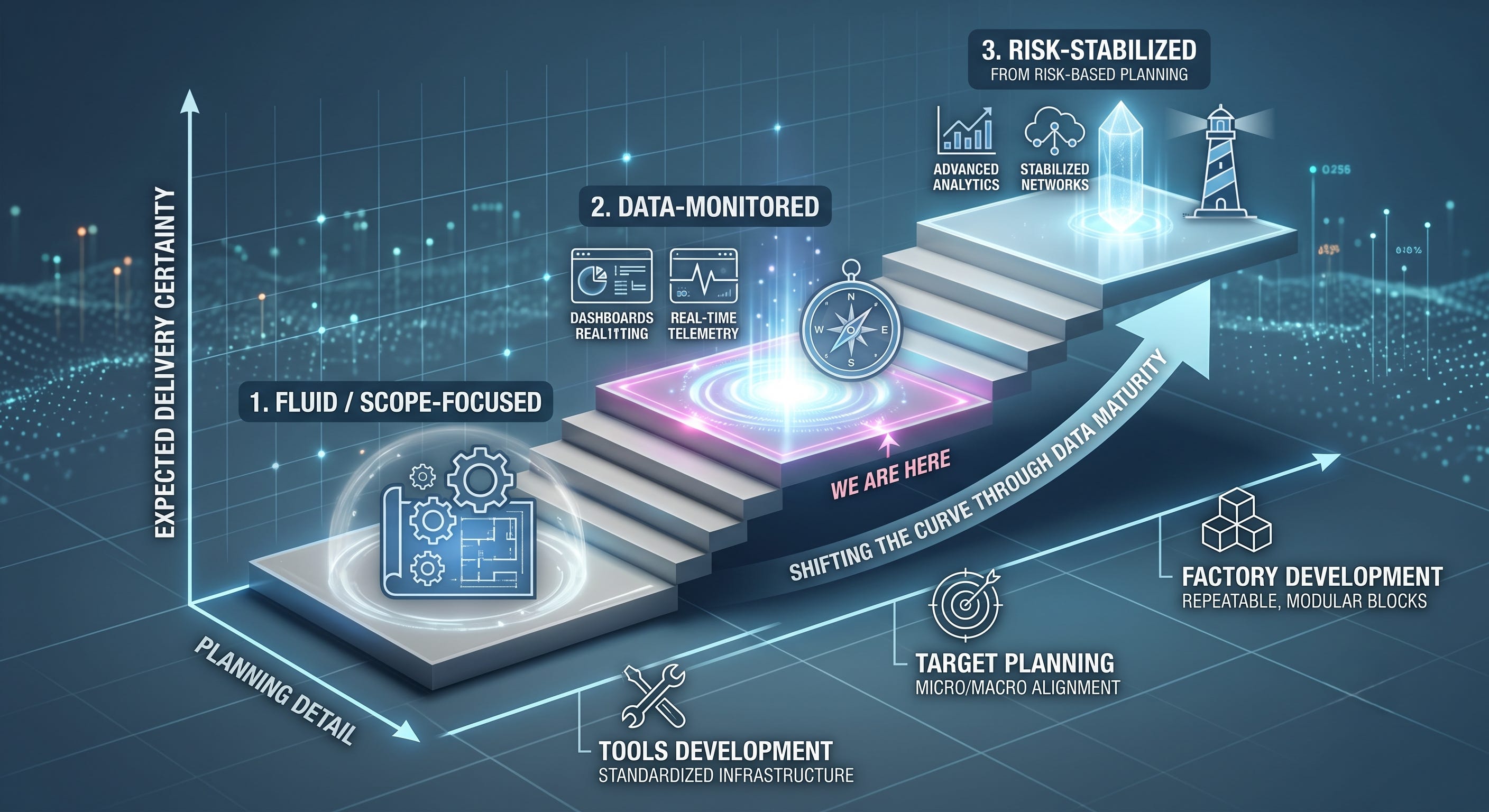
If we look at the framework mapped out in above image, project planning shouldn’t be treated as a guessing game. Instead, it functions as a progressive staircase of data maturity, divided into three distinct organizational archetypes.
The Three Estimating Archetypes: Where Do You Sit?
1. Baseline Planning (The Scope-Focused Mindset)
At this stage, predictability is anchored almost exclusively to high-level requirements. Teams spend their energy defining initial features and maintaining the scope as project parameters shift.
The Reality: Risk incorporation is treated as a conceptual recommendation rather than a data-driven model.
When it works: This archetype is perfect for early-stage feature exploration, rapid prototyping, or volatile environments where the target market changes daily. Trying to force granular tracking onto a baseline team is a recipe for bureaucratic paralysis.
2. Executable Planning (The Data-Monitored Mindset)
This is the operational frontier where most scaling engineering teams find themselves stuck (explicitly flagged as the “We are here” crossroad in image_71ea98.jpg).
The Reality: The organization shifts from intuition to empiricism. Estimates are grounded in explicit pre-contract development expertise, and timelines are continuously refined using real telemetry collected via active project monitoring.
When it works: This is a non-negotiable state when R&D milestones are directly tied to tight commercial deadlines. You build certainty by validating your forward-looking promises against actual historical velocity.
3. Risk-Based Planning (The Analytics-Stabilized Mindset)
This represents the highest tier of engineering predictability. Organizations operating here don’t just track their active projects; they mathematically insulate their portfolios against systemic volatility.
The Reality: Projections are built around stable, effective approaches to complex analytics. Teams explicitly build project objectives around system-wide dependencies, external supplier variables, and unexpected edge cases.
When it makes sense: This state is vital for complex system architectures, highly integrated hardware/software roadmaps, or high-stakes deployments where a single delay triggers a catastrophic domino effect across an entire product ecosystem.
Shifting the Curve: The Three Operational Axes
You cannot expect an engineering team to deliver Risk-Based Certainty if they are still using Baseline infrastructure. To safely move your organization to a higher data tier, you must deliberately invest across the three development axes:
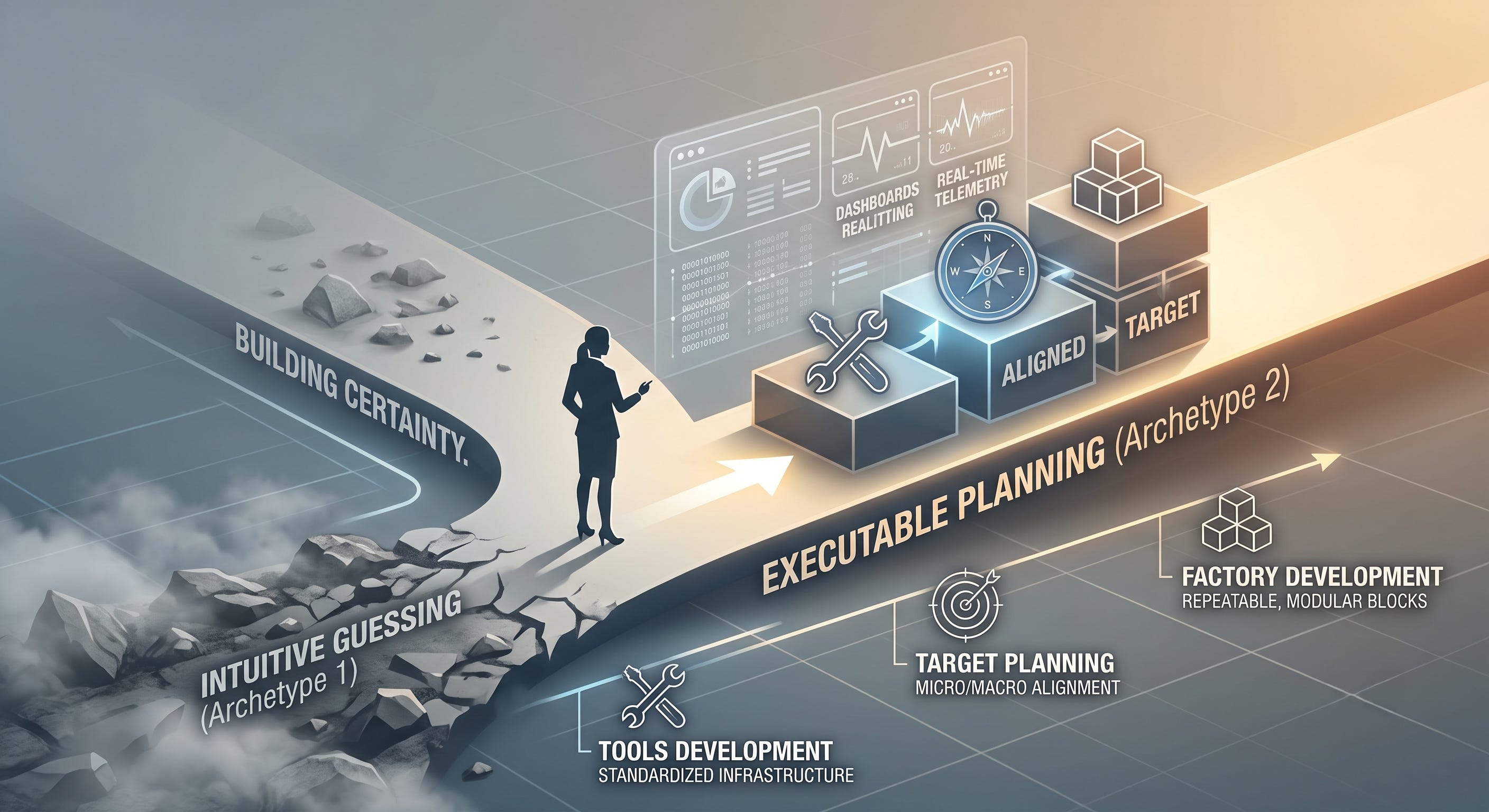
🔧 Tools Development: Standardizing the underlying infrastructure, tracking software, and automated templates needed to capture clean execution data without manual bias.
🎯 Target Planning: Ensuring that micro-milestones are dynamically aligned with macro strategic business windows.
🏭 Factory Development: Optimizing your core development blocks so that execution becomes as repeatable, modular, and measurable as a modern production line.
The Competency Pivot: Scaling Through the Ecosystem
The most profound realization is that advanced predictability eventually outgrows your internal team.
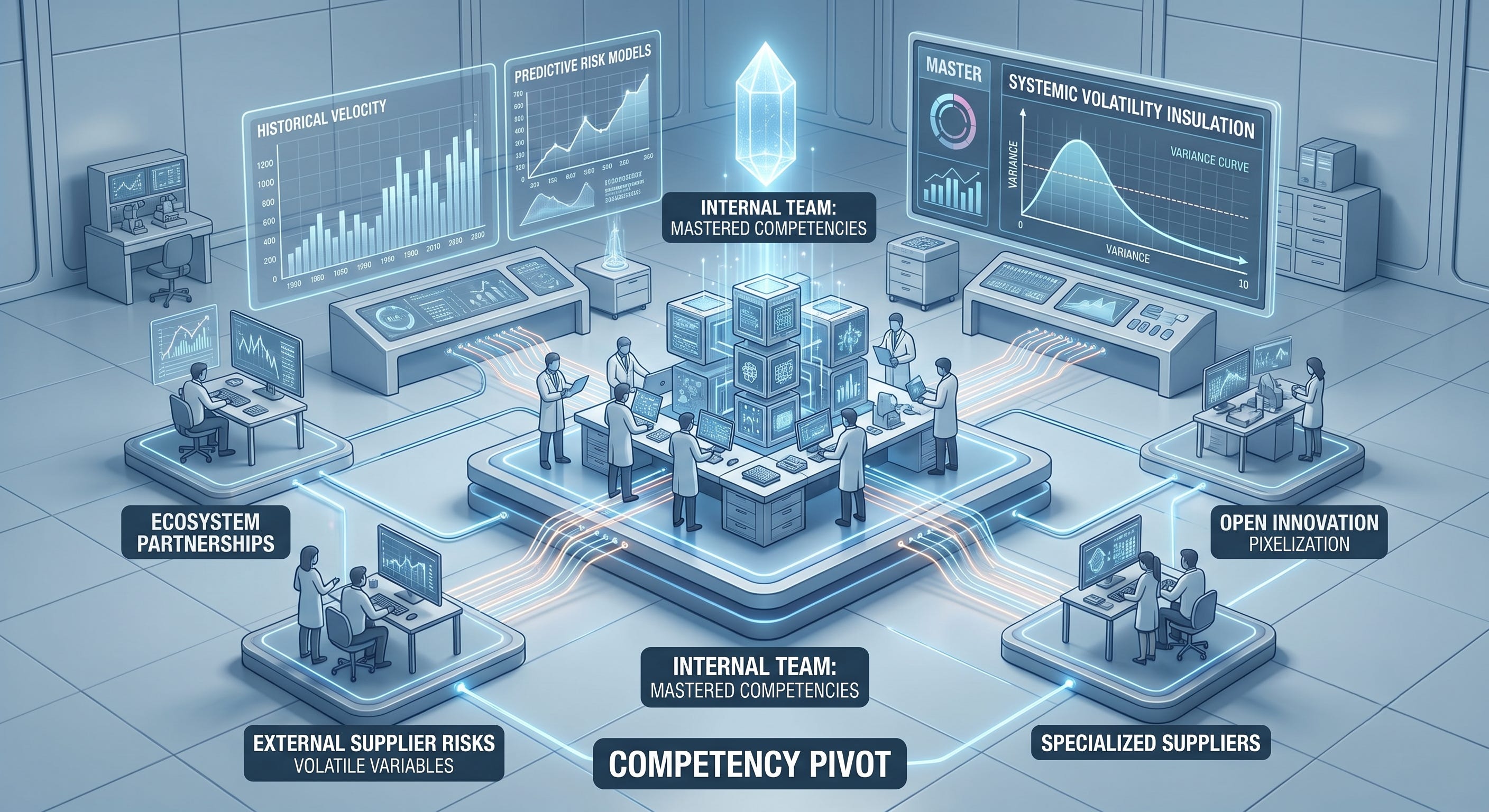
When projects reach a certain level of systemic complexity, you cannot eliminate estimation risk by relying solely on what your internal talent has currently mastered. To stabilize complex analytics and shield your roadmap from external shocks, your competency view has to evolve into a shared digital ecosystem.
By scaling up your internal enablers and seamlessly orchestrating external partnerships with specialized suppliers and startups, you unlock capabilities like open innovation pixelization and partner orchestration.
Instead of forcing your internal team to master every hyper-specialized technical unknown—which introduces massive estimation variance—you offload those volatile tracks to ecosystem specialists. Your core team keeps their eyes on the primary architecture, driving project variance down to zero.
The Bottom Line: Stop treating estimate quality as an engineering discipline issue. It’s an organizational architecture reality. Align your tools, fix your factory metrics, and build the right ecosystem interfaces. The predictability will follow.
When you audit your current project portfolio, do you find that your teams are struggling because they are being asked to deliver Step 3 certainty while only being equipped with Step 1 baseline tools?