



In software, a pivot costs a few thousand lines of code. In industrial R&D, a pivot can mean scrapping a $100,000 mold, waiting six months for a specialized material, or failing a UL certification that sets your roadmap back a year.
The tech world worships at the altar of “pure Agile.” But applying it verbatim to industrial sectors—where hardware, mechanical, material, and regulatory compliance are the law of the land—is a recipe for expensive chaos. To win in the age of Industrial AI and IT/OT convergence, we must move from Agile as a ceremony to Agility as a System of Work.
The Friction of Physics: Atoms vs. Bits
The fundamental mistake many organizations make is assuming “Agile” means “fast.” It doesn’t. In industrial R&D:
“Speed is a byproduct of systemic certainty, not just rapid iteration.”
When we develop a managed industrial switch, we aren’t just writing software. We’re managing multi-physics constraints. You cannot “sprint” through electromagnetic interference (EMI) or thermal dissipation. Gravity and physics don’t care about your two-week cadence. True speed comes from knowing—with mathematical certainty—that when you finally cut steel, the design will work.
A Three-Tiered System of Work
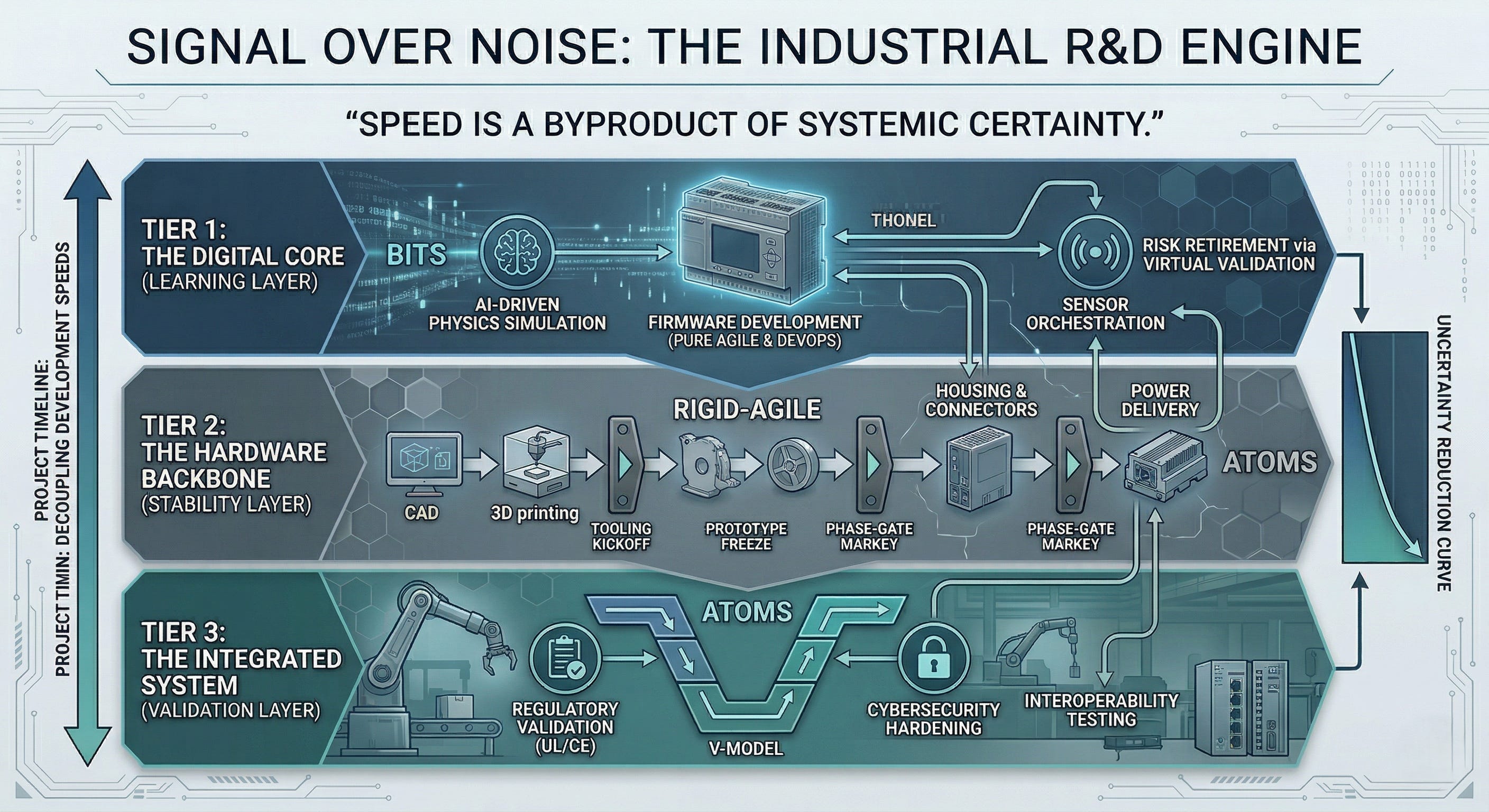
We don’t force every department into the same Scrum box. Instead, we use systems thinking to decouple development speeds, applying the Agile mindset where it has the highest leverage
.
1. The Digital Core (The Learning Layer)
Methodology: Pure Agile & DevOps.
Focus: Core AI physics simulations, networked sensor orchestration, and advanced firmware development logic.
Goal: Use AI-driven physics simulations to retire 80% of technical risk before the first physical prototype is even ordered.
2. The Hardware Backbone (The Stability Layer)
Methodology: “Rigid-Agile” (Iterative design with hard phase-gate fabrication).
Focus: Housing, PCBAs, connectors, and power delivery.
Goal: Respect the “Hard Gates” of tooling. We use sprints for design refinement, but we respect the reality that once a mold is cast or HW, PCBA samples are done the “sprint” is over.
3. The Integrated System (The Validation Layer)
Methodology: Systems Thinking (V-Model).
Focus: Regulatory validation (UL/CE), cybersecurity hardening, and system-level interoperability testing.
Goal: Ensure the signal of innovation meets the standard of safety.
The Missing Signals: Culture and Logistics
A system of work is only as strong as the people and the supply chain supporting it. To make systemic agility a reality, we address two often-ignored pillars:
The Cross-Functional Culture: We must bridge the “Respect Gap.” Software teams must understand that hardware isn’t “slow”—it’s permanent. Hardware teams must realize software isn’t “fickle”—it’s the primary engine of post-launch value. Agility requires empathy across the “Atoms vs. Bits” divide.
Agile Procurement: You cannot have a 2-week sprint if your components have a 26-week lead time. We integrate Procurement as a core R&D stakeholder, using “Design-for-Availability” to ensure our supply chain is as modular as our code.
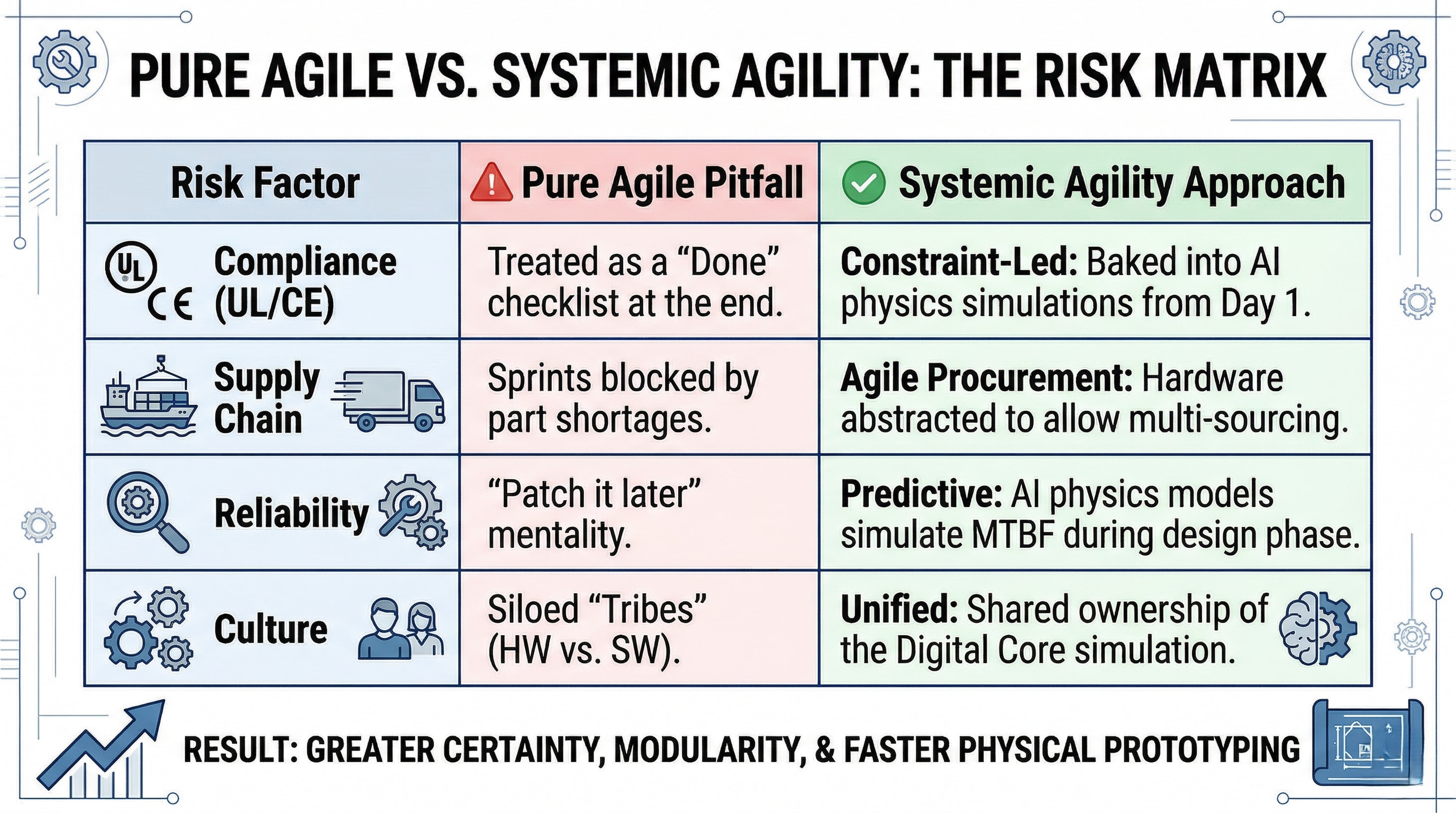
Pure Agile vs. Systemic Agility: The Risk Matrix
Agility Is a Mindset, Not a Methodology
We don’t need “more Scrum.” We need a system of work that respects the physics of atoms while leveraging the speed of bits.
Industrial R&D leaders should stop trying to make their engineers “more like Silicon Valley” and start making their systems more resilient, modular, and simulated. The goal isn’t to work faster—it’s to ensure that when we finally move to the physical layer, we do so with absolute certainty.