


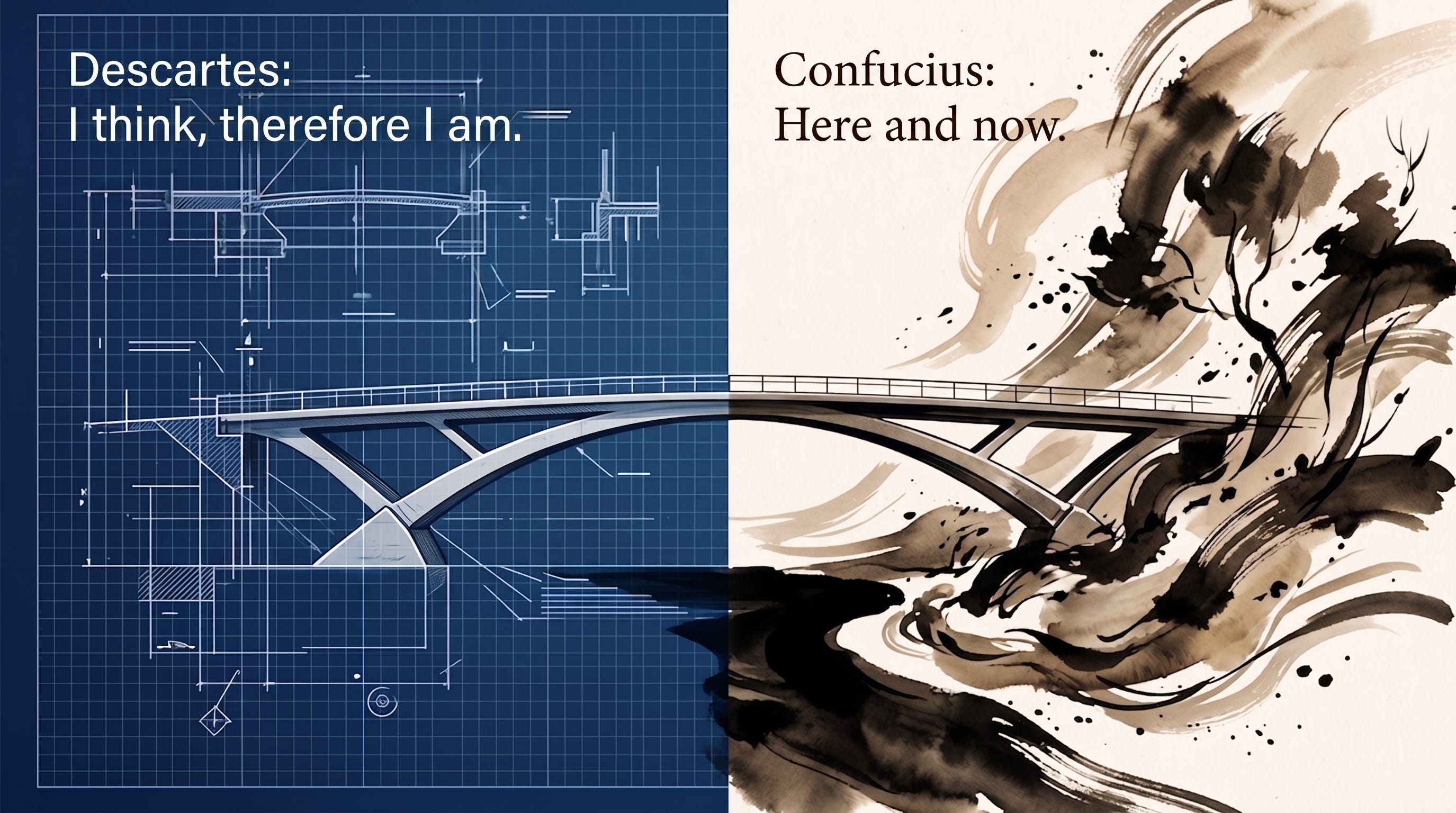
In every multinational program I’ve seen stall, the argument sounds the same.
One side says: “We can’t move until it’s defined.”
The other says: “We can’t define it until we move.”
It rarely starts as conflict. It starts as two competent groups doing what they believe is responsible.
But over time, execution slows—not because of tooling, time zones, or effort—because two different mental operating systems collide.
On one side sits Western rationalism rooted in René Descartes: Cogito, ergo sum (“I think, therefore I am”). On the other sits Eastern contextual pragmatism often associated with Confucian traditions: the “here and now,” where truth emerges through lived experience, relational dynamics, and real-time adaptation.
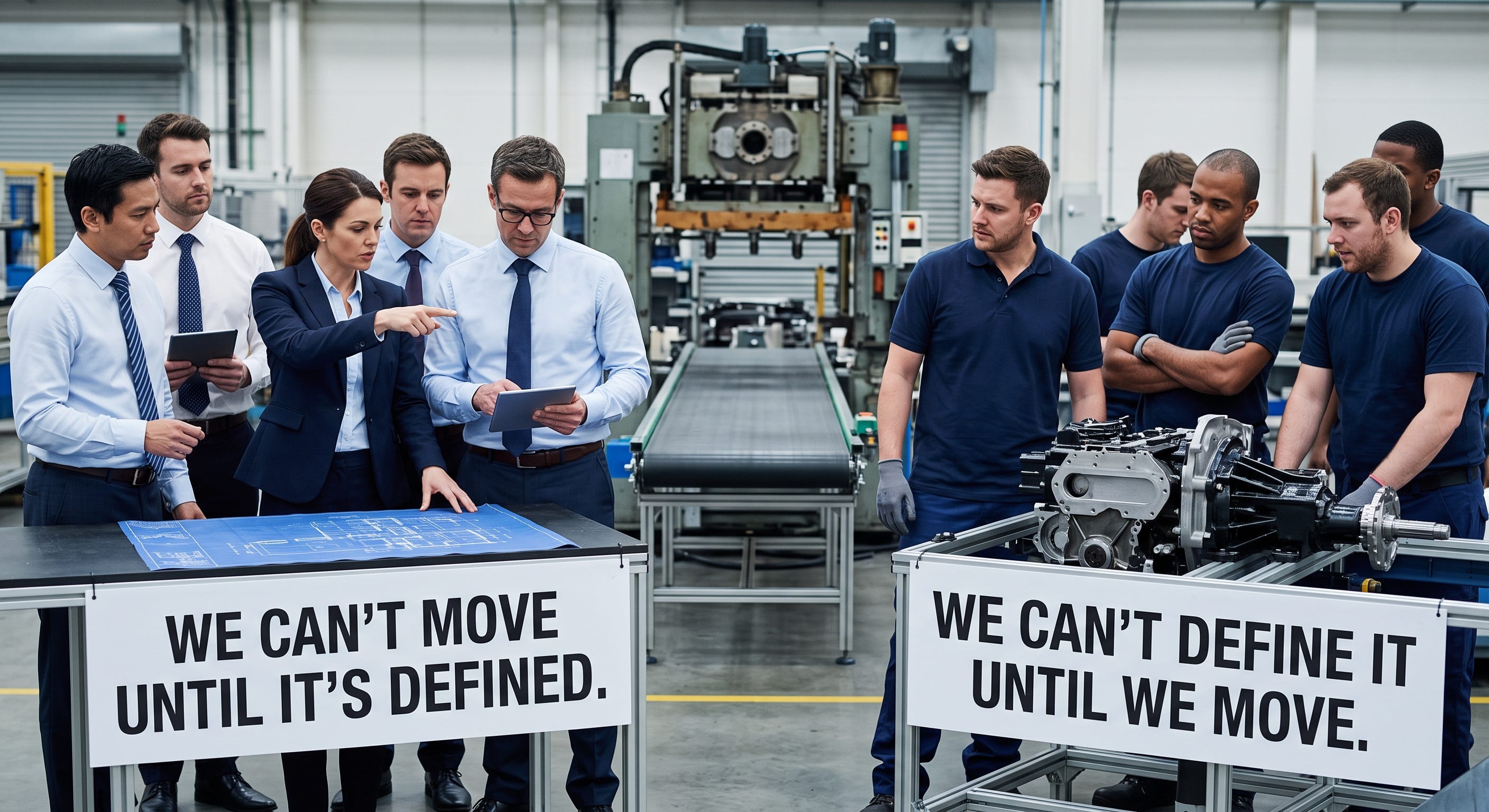
When leaders fail to recognize this divide, global execution grinds to a halt. The planners accuse the doers of undisciplined chaos; the doers accuse the planners of bureaucratic paralysis.
The fix isn’t choosing a side. It’s designing an operating model that orchestrates both.
Two Operating Systems in One Enterprise
Think of global execution as a spectrum.
Cartesian mindset → Systematic Certainty
Architectural rigor. Validated requirements. Predictable scaling.Confucian mindset → Kinetic Velocity
Situational awareness. Rapid iteration. Real-time adaptation.The Middle Path → Bounded Velocity
Explicit guardrails + autonomy to move fast inside them.
The mistake most enterprises make is treating one end of the spectrum as “correct,” then trying to convert everyone to it.
That strategy fails—because these are not just preferences. They’re deeply wired approaches to risk, truth, and decision-making.
The Cartesian Rationalist: “Blueprint Everything”
The vibe: “Blueprint everything down to the atomic level before committing resources.”
Cartesian thinkers optimize for coherence, predictability, and risk reduction. They ask:
What are the requirements and dependencies?
What’s the architecture and data model?
What will break at scale?
How do we prove this before it touches production?
They are the people who prevent an enterprise from building a fast-moving mess.
They create scalable architectures, governance mechanisms, clear interfaces, and operating procedures that hold under pressure.
The catch: paralysis by analysis.
In ambiguous markets—and in messy cross-cultural environments—Cartesian operating can become a loop. The program demands certainty before motion, but certainty is only obtainable after motion.
By the time the blueprint is mathematically “sound,” the context has shifted.
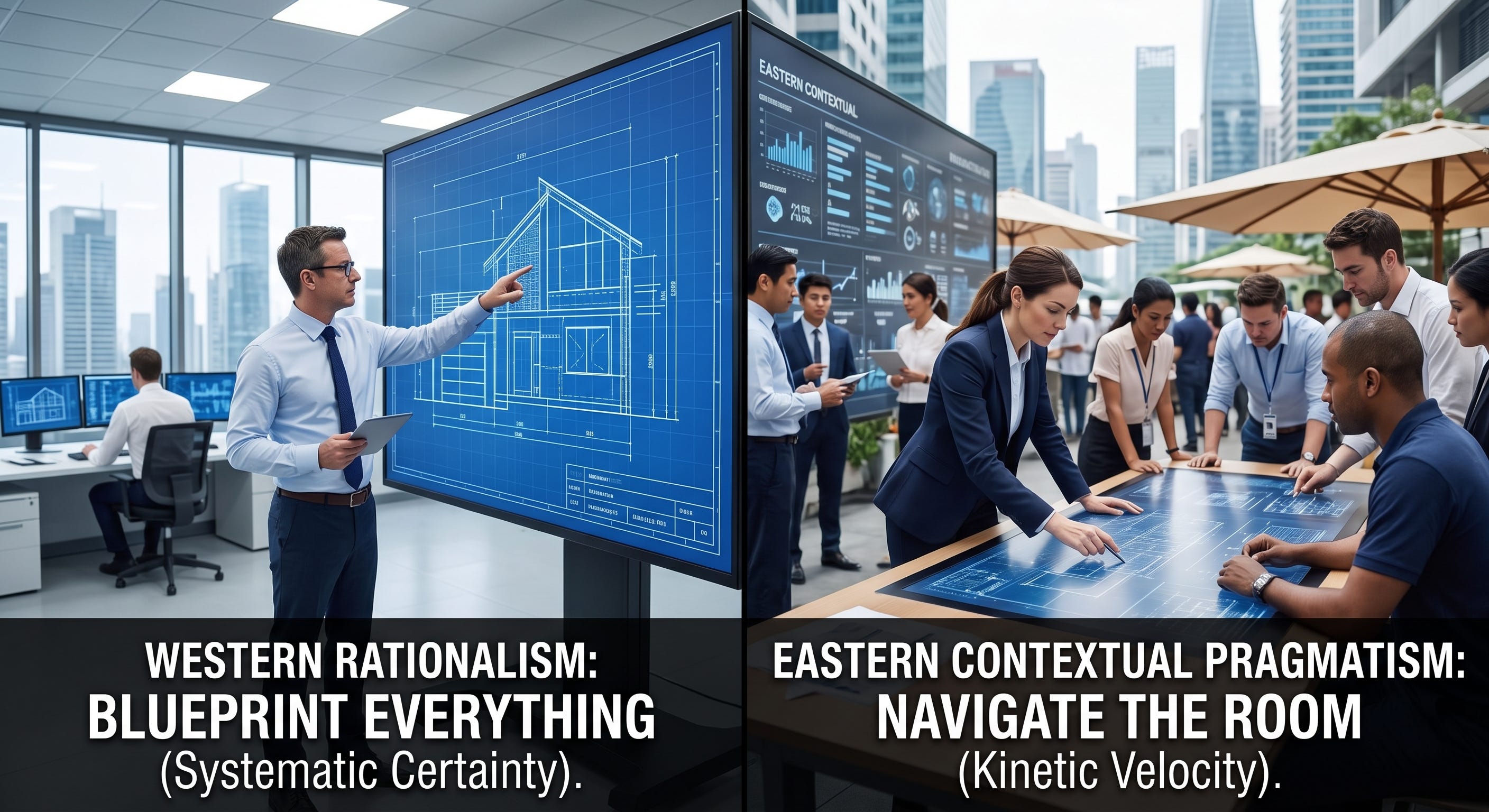
The Confucian Pragmatist: “Solve What’s in Front of Us”
The vibe: “Navigate by feel, adapt to the room, and solve what is directly in front of us.”
Confucian pragmatists optimize for traction, context, and speed. They ask:
What’s the customer feeling today?
What’s blocking the partner right now?
What can we test this week?
What’s the fastest path to reduce friction?
They thrive in ambiguity. They learn by doing, iterate quickly, and adjust in real time—especially where relationships, nuance, and local constraints matter as much as the written plan.
The catch: fragmented velocity.
Without structural anchors, iteration becomes churn. Teams move fast—but not in the same direction.
Local wins accumulate into global inconsistency. Technical debt and process debt compound quietly until the enterprise pays for it later in rework, integration failures, compliance exposure, and “surprise” outages.
Moving at 200 mph in four different directions is not agility. It’s organizational debt.
The Hidden Reason Global Execution Breaks
This clash is rarely named explicitly. Instead, it shows up as symptoms:
Roadmaps become weapons instead of coordination tools
Field teams route around governance (shadow decisions, local workarounds)
Central teams respond by adding gates and sign-offs → velocity drops further
Metrics diverge: “% complete” vs “customer impact this week”
Integration becomes late, painful, and political
Everyone is busy, and no one feels safe
In the same meeting, one person is optimizing for truth and another for traction.
The enterprise doesn’t need everyone to think the same way. It needs an operating model that allows both mindsets to contribute without destroying each other.
The Middle Path: Bounded Velocity as an Operating System
The Middle Path is not a compromise.
It’s an engineered design: non-negotiable boundaries (Cartesian rigor) paired with high autonomy (Confucian adaptation) inside those boundaries.

1) Bounded Velocity (Immutable Core, Adaptive Edge)
Do not apply the same operating model to every layer of the enterprise.
Apply unshakeable rigor only to boundaries that must not break.
Non-negotiable boundaries (Cartesian core):
System architecture principles (reference patterns, approved technologies)
Data contracts (schemas, ownership, retention, quality thresholds)
Interface protocols / APIs and versioning rules
Security, safety, and regulatory constraints
Operational “definition of done” for production (monitoring, rollback, audit)
Then explicitly grant teams autonomy where adaptation is required:
Autonomy inside boundaries (Confucian edge):
Experiment design and iteration cadence
Local market workflows and partner adaptations
Process tweaks that improve cycle time
Customer-facing messaging and enablement tactics
Implementation sequencing (as long as interfaces stay stable)
The boundary must be explicit enough that teams can move fast without asking permission.
Unclear boundaries create fear. Fear creates escalation. Escalation kills velocity.
2) Pair for Constructive Friction (Design the Tension)
Never allow analytical planners or situational operators to work in isolated silos. Pair them deliberately.
A simple staffing rule that scales:
Assign an Architect (coherence, risk, interfaces)
Pair with an Operator (speed, sensing, delivery traction)
Make them jointly accountable for outcomes and boundary integrity
Then install a lightweight cadence:
Weekly “Boundary Review” (30–45 minutes):
What did we learn in the field that threatens the plan?
What boundary was unclear or violated—and why?
What do we need to tighten vs relax?
This creates productive tension: the plan gets reality-tested early, and fast iteration stays channeled rather than chaotic.
3) Orchestrate, Don’t Convert (Leadership as Translator)
The primary job of global leadership is orchestration—not homogenization.
Stop trying to convert systematic thinkers into ad-hoc doers, or doers into systematic planners.
Instead:
Deploy Cartesian thinkers to architect the sandbox (boundaries, risk thresholds, integration rules)
Deploy Confucian operators to explore the solution space inside it (rapid learning, local adaptation, iteration)
Leadership should enforce boundaries and outcomes, not “style.”
When iteration becomes churn, intervene.
When governance becomes delay for delay’s sake, intervene.
When teams start fighting about who is “right,” translate the operating intent: coherence at the core, speed at the edge.
A Practical Blueprint: Implementing the Middle Path in 30 Days
If you want this to become real (not just philosophical), install it like an operating system.
Week 1: Define boundaries (one page, not sixty)
List 5–7 non-negotiables (architecture, data, security, regulatory, interfaces)
Define who owns each boundary and how exceptions are handled
Week 2: Create architect–operator pairs
Assign pairs per workstream (not per function)
Give them a shared scorecard: cycle time + boundary integrity
Week 3: Install a decision loop and decision log
Weekly boundary review (30–45 minutes)
Log decisions and why they were made (prevents re-litigating)
Week 4: Measure what matters
Pick two metrics that reveal whether you’re actually achieving the Middle Path:
Decision cycle time (days from issue → decision)
Rework rate (work reversed due to late integration/boundary breaks)
If cycle time drops but rework explodes, you’re sprinting without an anchor.
If rework drops but cycle time explodes, you’re over-architecting.
The Line That Should Guide Global Operations
Rigor without speed is paralysis.
Speed without rigor is chaos.
The art of multinational execution is building a structural foundation strong enough that teams can sprint in the present moment without breaking the machine.
The enterprises that win won’t be the ones that enforce rigid corporate uniformity. They will be the ones that master the Middle Path—anchoring their core with Cartesian discipline while empowering their global edges to navigate the here and now.
Where does your organization naturally stall under pressure—over-architecting the plan, or sprinting without an anchor?