



Welcome to the desert of the real.
Every single day, engineers, developers, and corporate leaders wake up to a residual self-image built on Outlook notifications, frantic Microsoft Teams pings, and an endless onslaught of “ASAP” and “RE: Urgent” subject lines. It is incredibly easy to take the Blue Pill—to accept this simulated reality, put your head down, and mistake a reactive state of pure busywork for actual progress.
But true leaders choose the Red Pill. They choose to step back, slow down, and see the system for what it is.
Analysis isn’t about speed; it’s about pausing. If you want to wake your team up from the corporate simulation and unleash true internal innovation, you have to break the loop by asking the ultimate question: What problem are you solving?
Here is the strategic R&D blueprint to help your teams stop dodging bullets, bend the corporate code, and reconstruct solutions from the ground up.
1. Stopping the Bullets: Situation Appraisal
Morpheus once told Neo that when he was ready, he wouldn’t have to dodge bullets. In the corporate landscape, every unvalidated task, chaotic escalation, or frantic email is a bullet in motion. If your team spends the entire day dodging them, they are just reacting to the simulation.

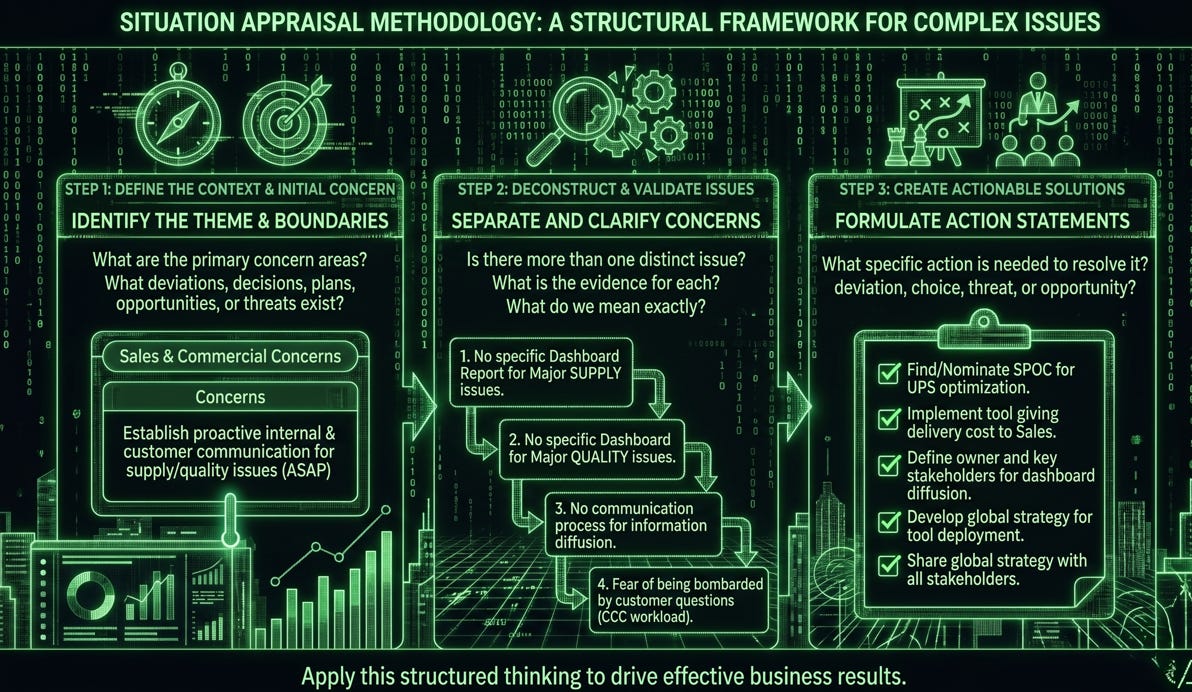
To stop the noise, you must apply a rigorous Situation Appraisal Methodology to map the theme and establish boundaries:
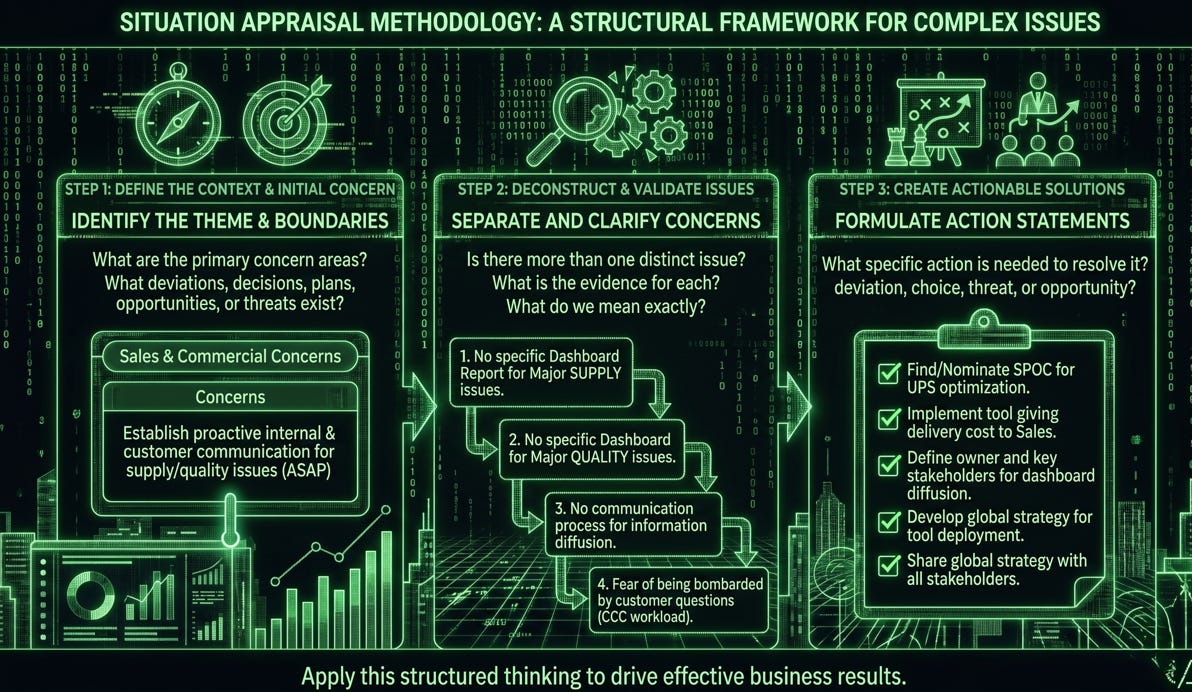
Step 1: Define the Context & Initial Concern. Identify the primary concern areas. What deviations, threats, or opportunities actually exist? Don’t look at the surface-level panic; map the boundaries of the system glitch.
Step 2: Deconstruct & Validate Issues. Isolate individual pain points. Separate and clarify concerns by asking: Is there more than one distinct issue here? What is the concrete evidence for each? What do we mean exactly? A broad, overwhelming “commercial or operational concern” usually breaks down into highly specific glitches—like missing reporting dashboards, broken communication processes, or severe support overloads
.
Step 3: Create Actionable Solutions. Formulate precise, targeted action statements. Every validated glitch needs a direct code patch—nominating a Single Point of Contact (SPOC), deploying a specific tool, or implementing a clear global strategy to handle the deviation.
2. Bending the Code: Deep Customer Discovery

Once you stop the bullets of corporate noise, the matrix code strips away, leaving a monochrome field of pure process and data. But you cannot fix a human system with raw data alone; you have to bend the code. That requires stepping into the shoes of the users living inside the system through genuine customer discovery.
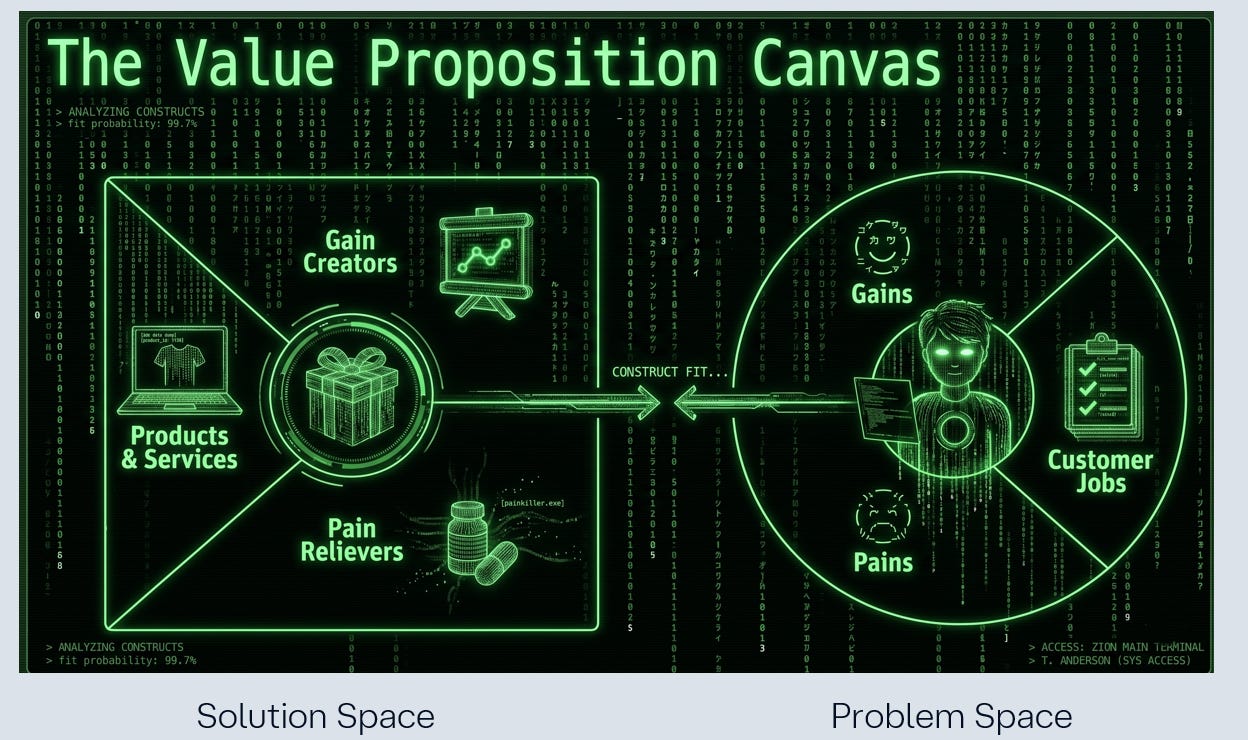
This means auditing your Problem Space against your Solution Space using a strict Value Proposition Canvas to establish a perfect construct fit.
To do this, analyze your stakeholders through a radical empathy lens:
Map what they are actually saying and doing against what they truly think and feel.
Expose their explicit Pains—the roadblocks, legacy manual overheads, and operational fears keeping them trapped.
Target their desired Gains—the transparency, predictability, and optimization they need to thrive.
The Golden Rule of the Nebuchadnezzar: Your solution must explicitly serve as a Pain Reliever or a Gain Creator. If it does neither, delete the task from your terminal.
3. The Oracle’s Pitch: Mastering the Delivery
Neo went to the Oracle to understand his purpose, but she didn’t just give him a technical breakdown; she told him exactly what he needed to hear to discover his own path. An extraordinary, data-driven solution means absolutely nothing if your team cannot pitch it to the “Architects” of your company—the executive management team.
To successfully move an idea out of the training construct and into real-world deployment, you must master the exact Anatomy of a Pitch:
Know Your Audience: Speak directly to their strategic priorities, completely deleting technical engineering jargon.
Tell a Story: Frame a compelling narrative journey from the initial glitch to the ultimate solution.
Explain What’s in It for Them: Clearly state the immediate return on value and operational impact.
Show and Tell: Use virtual designs, high-fidelity mockups, or videos to make the concept tangible.
Get Social Proof: Prove validation by leveraging feedback from internal proxies, sales champions, or initial stakeholder testing.
State Your Ask: Never close a presentation with a passive “thank you” slide. Make a direct, concrete request for resources, budget, or authority to execute.
To maintain absolute brevity, every team member must be able to summarize their vision using this foundational Elevator Pitch Sentence Structure:
FOR (target customer), WHO HAS (customer need), THE (product name) IS A (market category) THAT (one key benefit). UNLIKE (competition), THE PRODUCT (unique differentiator).
Conclusion: Free Your Mind
Corporate disruption cannot survive in a rigid, purely reactive environment. As leaders, our ultimate job is to construct spaces where teams develop a deep comfort with ambiguity.

Ambiguity isn’t something to fear; it provides the playground for curiosity. Curiosity is what fuels our adaptability, and adaptability is what ultimately demands—and unlocks—true organizational creativity.
The door is open. You just have to step through it.